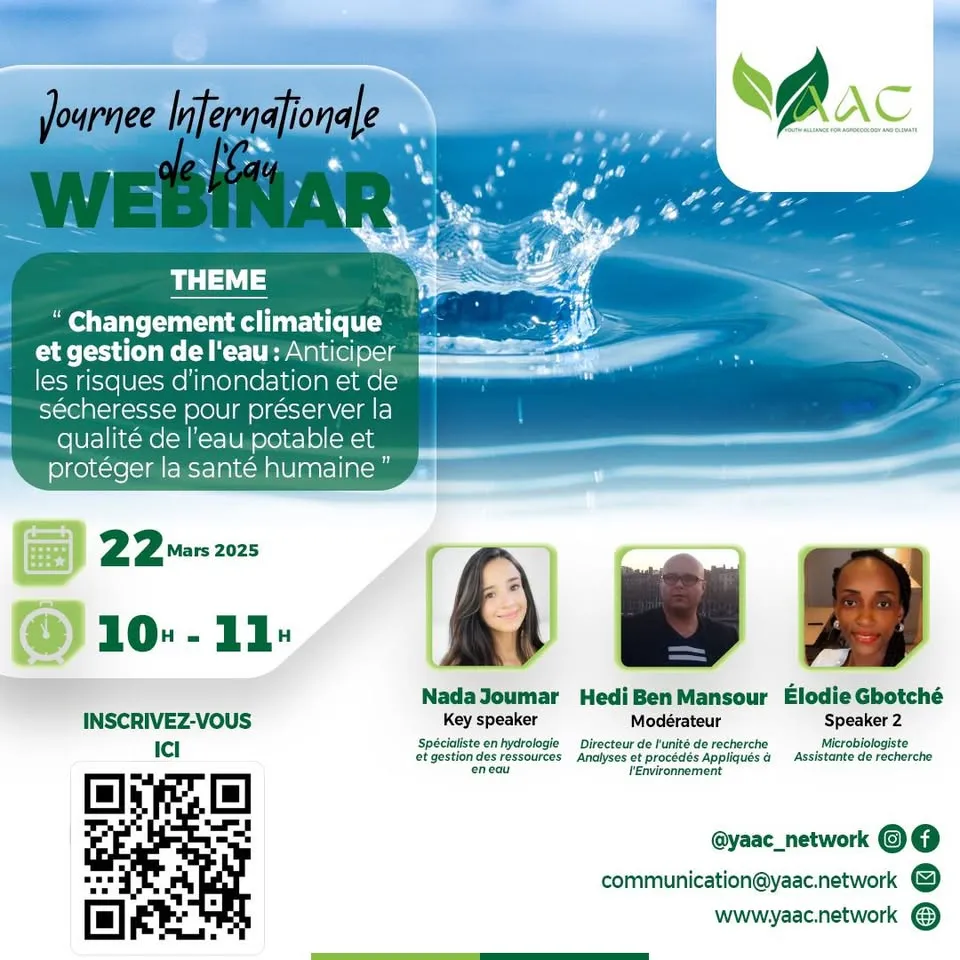
On 22 March 2025, for World Water Day, the Youth Alliance for Agroecology and Climate held its first international webinar. It did not yet belong to a series. Only in hindsight did it become YAAC Talk #1.
From 10:00 to 11:30 GMT, the session followed a precise chain of consequences: “Climate change and water management: anticipating flood and drought risks to preserve drinking water quality and protect human health.”
Why begin with water
The choice was deliberate. You cannot discuss climate, farming, health, biodiversity or food security without discussing water — it is the resource where all of those meet. A flood destroys a harvest; a drought moves a herd; microbial contamination fills a clinic. One disruption, three consequences that are usually handled separately.
Two scientific contributions
The session was moderated by Prof. Hedi Ben Mansour, head of the research unit “Analysis and processes applied to the environment” at ISSAT Mahdia, University of Monastir, Tunisia.
After an introduction to the network, its vision, mission and values, two researchers spoke:
- Nada Joumar, a specialist in hydrology and water resource management, on understanding and managing flood risk — the science first, then what actually holds up in the field.
- Élodie Gbotché, microbiologist and research assistant, on how climate change affects the microbiological quality of water.
An open question session then allowed participants to speak directly with the presenters.
What this meeting started
The significance of this first edition lies less in its content than in what it made possible. It laid the foundation for a regular series bringing scientists, young researchers, field practitioners, decision-makers and civil society onto the same platform.
The ambition is easy to state and demanding to keep: let scientific knowledge meet the realities of the field, and let dialogue lead to action. In practice, YAAC Talk works to connect science, public policy and citizens, to bring young people into environmental debates, to give African expertise its place, and to strengthen collaboration between researchers, professionals and organisations.
The conversation began with water. It continues with every new edition.